
Electric Scooter in India vs Petrol Scooty: Which One Makes More Sense in 2026?
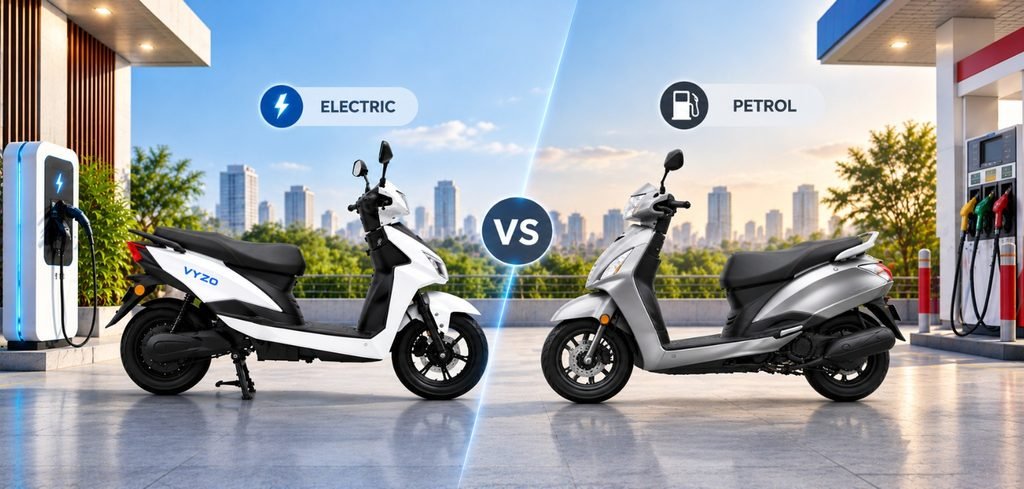
The debate between a petrol scooter and an electric scooter in India has shifted dramatically over the last few years. What used to be a simple “range anxiety vs convenience” argument has turned into a much closer contest — electric models now offer real range, lower running costs, and in many cases, zero paperwork. But petrol scooters still have their place for certain riders. This comparison breaks down exactly where each option wins, so you can decide which makes more sense for your 2026 commute.
Running Cost: The Biggest Difference
This is where the gap is the widest, and it’s the main reason so many buyers are switching. A petrol scooter typically costs between ₹4 and ₹6 per kilometer to run, depending on current fuel prices and mileage. An electric scooter, by comparison, usually costs under ₹1 per kilometer to charge.
| Factor | Petrol Scooter | Electric Scooter |
| Cost per km | ₹4-₹6 | ₹0.50-₹1 |
| Monthly fuel/charging cost (30 km/day) | ₹3,600-₹5,400 | ₹450-₹900 |
| Annual savings potential | — | ₹35,000-₹50,000+ |
Over a year of daily commuting, this difference alone can be enough to offset a large part of what you’d spend buying a battery operated scooter in the first place. This is one of the main reasons the electric scooty price conversation has shifted — buyers now look at total cost of ownership, not just the upfront number.
Maintenance: Fewer Moving Parts, Fewer Headaches
Petrol scooters need regular servicing: oil changes, spark plug replacement, carburetor cleaning, and clutch adjustments. Each of these adds up in both cost and time spent at a service center.
Electric scooters simplify this considerably. With no engine, no oil, and no exhaust system, the maintenance checklist shrinks to tyres, brakes, and periodic battery health checks. Most owners report significantly lower annual maintenance bills with an EV compared to a petrol equivalent.
That said, battery replacement is the one major cost electric scooter owners need to plan for — typically needed after 3-5 years depending on usage and battery quality. This is why checking battery warranty terms matters so much when comparing an e scooter price in India across different sellers.
The Licensing Question: A Major Advantage for Electric
Here’s where electric scooters pull ahead in a way petrol scooters simply can’t match. Every petrol scooter, regardless of speed or power, requires:
-
- A valid driving license
-
- RTO registration and a number plate
-
- Mandatory insurance
A non-RTO electric scooter, on the other hand, operates under a completely different set of rules. If it meets the government’s classification — motor power up to 250W and top speed capped at 25 km/h — it qualifies as an electric scooter without driving license. No RTO registration, no license test, no number plate requirement in most states.
This single factor makes a low speed electric scooter 25 kmph an extremely attractive option for:
-
- Students who haven’t yet gotten a driving license
-
- Homemakers running short daily errands
-
- Senior citizens who want a simple, hassle-free vehicle
-
- Anyone who simply wants to skip the RTO process entirely
Petrol scooters offer no equivalent — there’s no license-free category for them at all.
Performance and Range: Where Petrol Still Has an Edge
This is the one area where petrol scooters still hold an advantage, particularly for long-distance or highway riding. A full tank typically gets you 250-400 km depending on the model, and refueling takes under five minutes at any petrol pump.
Electric scooters, especially in the low price electric scooter in India segment, usually offer 60-100 km per charge, with charging times of 4-6 hours for a full cycle. For riders with long daily commutes or frequent highway travel, this is a real consideration. However, for the vast majority of urban and semi-urban riders — whose daily usage rarely exceeds 30-40 km — this limitation matters far less than it seems on paper.
| Factor | Petrol Scooter | Electric Scooter |
| Range per fill/charge | 250-400 km | 60-150 km (varies by model) |
| Refuel/recharge time | Under 5 minutes | 4-6 hours (full charge) |
| Best suited for | Long-distance, highway riders | Short daily commutes, city use |
Environmental Impact: A Clear Win for Electric
Petrol scooters emit carbon dioxide, carbon monoxide, and particulate matter with every ride. In cities already struggling with air quality, this adds up fast across millions of two-wheelers. Electric scooters produce zero tailpipe emissions, and as India’s electricity grid gradually shifts toward renewable sources, the overall environmental footprint of EVs continues to improve.
This isn’t just a feel-good factor — several Indian cities are actively tightening emission norms and introducing restrictions on older petrol vehicles. Choosing an EV scooter price in India today may also mean avoiding future compliance costs as regulations evolve.
Which One Should You Actually Choose?
The honest answer depends on your riding pattern, not on which technology is objectively “better.”
Choose a petrol scooter if:
-
- You regularly travel long distances or ride on highways
-
- You don’t have reliable charging access at home or work
-
- You need a vehicle immediately with zero charging downtime ever
Choose an electric scooter if:
-
- Your daily commute is under 40-50 km
-
- You want to cut monthly running costs significantly
-
- You’d rather skip license and RTO paperwork (non-RTO category)
-
- You care about reducing your environmental footprint
For most urban commuters, especially those exploring the best non-RTO electric scooter in India 2026 category, the electric option now makes more practical and financial sense than it did even two years ago.
Visiting a Showroom Before You Decide
Numbers on paper only tell part of the story. Before committing either way, it’s worth visiting an electric scooter showroom near me to test ride a few models and compare how they actually feel — acceleration, brake response, seat comfort, and build quality all vary significantly between brands and categories.
Chandel Automotives Private Limited offers exactly this kind of hands-on experience, letting riders compare non-RTO and higher-range electric models side by side before making a decision. Speaking directly with an experienced electric scooter dealer also helps clarify questions around warranty, service support, and which model genuinely fits your daily routine — information that’s hard to get from online listings alone.
Final Verdict
Petrol scooters aren’t obsolete — they still make sense for specific use cases like long-distance travel or areas with poor charging infrastructure. But for the average Indian commuter riding short, predictable daily distances, the case for switching to an electric scooter in India has never been stronger. Lower running costs, minimal maintenance, and in the case of non-RTO models, zero licensing hassle combine to make electric the more practical choice for 2026 and beyond.
If you’re still unsure, start by visiting Chandel Automotives Private Limited or a similar dealer near you, test ride both categories, and make the decision based on your actual daily riding pattern rather than general assumptions.